The 110% Rule: How Much a Mover Can Charge at Delivery
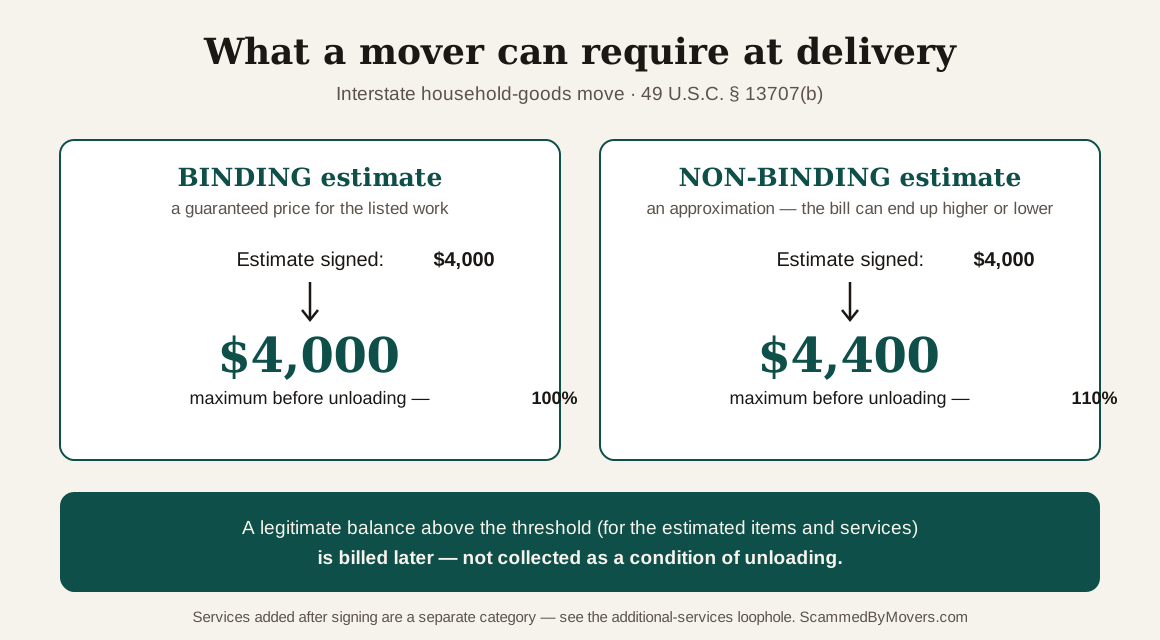
The short answer: on an interstate move, a mover may require at delivery, before releasing your goods, 100% of the charges on a binding estimate or not more than 110% of the charges on a non-binding estimate. A legitimate balance beyond that for the estimated work is billed later — not collected at the door.
There is one number at the center of almost every interstate “hostage load” dispute: how much a mover can require you to pay at the door before they have to hand over your belongings. Federal rules set that ceiling, and it depends entirely on which kind of estimate you signed.
This is general information, not legal advice, and it does not analyze your specific move. If money is on the line, consider talking with a licensed attorney in your state. What follows is the rule, the threshold, and the exception, so you can read your own paperwork against it.
The ceiling depends on your estimate type
On an interstate household-goods move, the law distinguishes between a binding estimate and a non-binding estimate. Both kinds are governed by FMCSA’s rules on estimating charges, found in Subpart D of the household-goods regulations.[5]
- Binding estimate. The mover may require payment of 100% of the charges in the binding estimate before relinquishing possession at delivery.[3] A binding estimate is a guaranteed price for the items and services listed on it.
- Non-binding estimate. The mover may require no more than 110% of the charges in the non-binding estimate before relinquishing possession at delivery.[4] A non-binding estimate is an approximation of the cost — the final bill can come in higher or lower.
Both ceilings trace back to the same statute. Under 49 U.S.C. § 13707, a carrier transporting household goods may be required to relinquish possession at delivery when the shipper tenders 100% of a binding estimate or 110% of a non-binding estimate.[2] FMCSA describes the same thresholds in plain language and frames a refusal to release after proper payment as holding a shipment hostage in violation of federal law.[1]
”For the same items and services” is the load-bearing phrase
The ceiling applies to the items and services that appear on the estimate. The estimate is a snapshot of an agreed scope of work — the inventory, the origin and destination, and the services (packing, stairs, long carry, and so on) the mover priced.
That scope is the whole game. When a mover stacks on charges for work that was not on the estimate, those charges sit outside the 100% / 110% comparison. That is the single most common way a delivery demand balloons past the ceiling, and it is important enough to have its own guide.
A legitimate remaining balance on a non-binding move is billable — but not at the door
Here is the part that surprises people. On a non-binding move, if the final, properly-documented charges come to more than 110% of the estimate, the mover does not get to hold your goods until you pay all of it. The mover must release the shipment on payment of the 110%, and then bill the rest.
FMCSA states that when the bill exceeds 110% of a non-binding estimate, the mover must relinquish possession at delivery upon payment of the 110% and defer billing for the remaining charges for at least 30 days.[1] In other words, a genuine remaining balance is something you may owe — but it is generally due roughly 30 days after delivery, not as a condition of getting your furniture off the truck.
Do I have to pay movers before they unload?
Generally yes — up to the threshold. The release rule cuts both ways: the mover may require payment of the applicable amount (100% of a binding estimate, or up to 110% of a non-binding one) before relinquishing the shipment.[2] Declining to pay anything at delivery is not what the hostage-load protections address — they concern demands above that figure for the items and services on the estimate.
Check your numbers
If you have your estimate amount and the dollar figure the mover is demanding at delivery, you can compare them against the threshold directly.
Check your numbers in the Overcharge Checker → It shows the 100% or 110% release threshold for your estimate type and how far the demand sits above or below it. It does not render a verdict — it reports the rule and the gap.
First, confirm the rule even applies
Everything above is federal, and federal rules apply to interstate moves — moves that cross a state line. A move that stays inside one state is regulated by that state, not by FMCSA, and the 100% / 110% thresholds above may not apply. Before you rely on any of this, confirm which kind of move you had: see Interstate vs. intrastate: who actually regulates your move.
If you are past the ceiling
If the demand at delivery is above the threshold for your estimate type and the extra is not explained by documented additional services, here is the ordered path for raising it — including the federal complaint database.
What you can do, step by step
-
Get all your paperwork in hand
The written estimate(s), the bill of lading, your contract, and any texts or emails. Every step below needs these. Photograph everything.
-
Calmly point to the contract and the rule
Show the mover the estimate and the 100% / 110% release figure, and ask for an itemized bill in writing. Many disputes end here. It won’t force release if the mover refuses.
-
File an FMCSA hostage complaint — interstate moves only
File with the National Consumer Complaint Database and upload your estimate and bill of lading. It puts the mover on the federal enforcement radar. It cannot recover your money or act instantly.
NCCDB: nccdb.fmcsa.dot.gov · 1-888-368-7238 (1-888-DOT-SAFT).
How to file, step by step → -
File with your state attorney general’s consumer-protection division
This is the office that can actually investigate — and the only real path for an intrastate (in-state) move.
-
File a BBB complaint
Public pressure and mediation. No legal force, but it creates a record and sometimes moves a mover to settle.
-
If you paid by credit card: a dispute may be available
The Fair Credit Billing Act lets a cardholder dispute a billing error in writing — including a charge for services not delivered as agreed — generally within 60 days of the statement. Whether a charge qualifies depends on the facts.
-
Local law enforcement or a civil attorney
For a true refusal to deliver, a police report and a consultation with a civil attorney are the paths to getting goods back or recovering money.
Sources
Every legal claim above links to one of these official sources. Rules change — check the source if you're acting on this.